

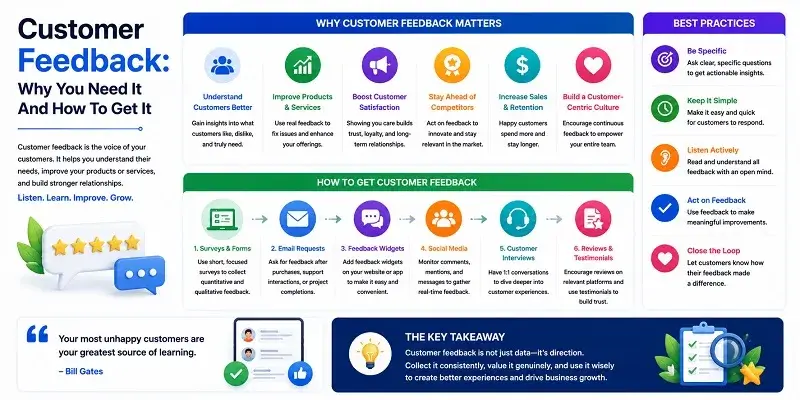
In today’s competitive digital world, guessing what customers want isn’t enough anymore. Steady-growing businesses listen to customers, learn from their feedback, and make improvements. Customer feedback drives this process. If you have a small business, an online shop, or a growing brand, knowing what your customers think is key. It can help you make better choices and succeed in the long run.
Customer feedback is not entirely opinions and reviews. It is first-hand experience with your customers. When used well, it is a strong tool for improvement, trust, and growth.
What Is Customer Feedback?
Customer feedback reveals what people truly feel about your product, service, or brand experience. It shows what’s going well, where you can improve, and what customers want from your business. To boost your agency’s brand visibility, listen to customer feedback. Use their insights to improve your services and enhance your reputation.
This feedback may focus on:
- Product quality
- Service experience
- Ease of use
- Pricing perception
- Support satisfaction
Every response offers important insights. These insights help businesses understand their audience and improve communication strategies. Effective audience engagement tools help to accurately analyze customer behavior, preferences, and interactions.
Why Customer Feedback Is So Important
The customer respondent is important in defining the business strategy. It assists business organizations in shifting between assumptions and decisions.
Helps Improve Products and Services
Feedback indicates actual problems and opportunities. You don’t have to rely on your inner voices. Instead, you can talk directly to customers to find out what needs fixing or improving.
Builds Trust and Loyalty
By making customers feel valued, they feel listened to. Responding to feedback shows your business cares. This builds trust and loyalty over time.
Helps in Making Better Decisions
Feedback provides clarity. It informs product changes, service enhancements, and content policy with practical feedback.
Supports Better Decision-Making
Understanding pain points helps you improve the customer experience. It lets you remove friction at every stage.
Enhances Brand Reputation
Companies that hear feedback and respond appear transparent, trustworthy, and customer-focused.
The Customer Feedback Contribution to Growth
Growth is not only in the sense of gaining new customers but also in maintaining the existing ones. Customer feedback helps us understand why people return and why they leave.
Businesses can analyse the feedback trends and:
- Reduce customer churn
- Increase satisfaction
- Improve retention rates
- Enhance brand credibility
The continuous growth is sustainable due to improvements based on feedback.
Types of Customer Feedback
It is important to learn the types of feedback to gather deeper insights.
Direct Feedback
This includes customer feedback when they share their opinions, suggestions, or complaints.
Indirect Feedback
Behavioral indirect feedback comes from how users engage, act, or interact for support.
Qualitative Feedback
It focuses on words and descriptions. This helps you understand feelings, expectations, and desires.
Quantitative Feedback
This will include ratings or responses; they help measure satisfaction and performance. The mix of feedback types will give a clearer view of customer sentiment.
How to Collect Customer Feedback Effectively
Customers should find the process of feedback collection easy and comfortable. The more convenient it is, the more truthful and helpful the answers you will get.
Ask at the Right Time
Timing matters. Seek feedback right after an interaction. This way, experiences are fresh and accurate.
Keep It Simple
Brief and specific questions stimulate responses. Forms that are too long tend to lower the response rates.
Be Clear About Purpose
Educate the customers about the importance of their feedback and its application.
Use Simple and Approachable Words
Avoid technical terms. The use of simple language promotes straightforward and reflective answers.
How to get customer feedback in the best way
You can gather feedback in several easy ways that won’t overwhelm customers.
Surveys and Questionnaires
Open-ended questions are used to gather targeted feedback and gauge levels of satisfaction.
Reviews and Ratings
Customer reviews give candid and free views that point out the strong and weak areas.
Direct Communication
One-on-one communication provides more insights and elaborations.
Feedback Forms
Easy-to-reach forms let customers share their thoughts quickly, anytime.
Social Listening
Observing the online discussions assists in capturing raw views and trends.
Both methods serve different purposes. When combined, they increase accuracy.
The Way to Make Customers Give Feedback
Customers have many clients ready to give feedback, but they need some convincing.
You can get more responses by:
- Being polite and respectful when asking.
- Making the process fast and simple.
- Demonstrating respect for their time.
- Showing that feedback results in action.
As customers are witnessing true improvements, they will be more likely to repeat.
The Customer Feedback Analysis
Gathering feedback is not the entire process. The correct way of analyzing it is what adds value.
Look for Patterns
Comments stated in a repetitive way may signify significant problems or advantages.
Distinguish between Emotion and Action.
Know emotions, but put action into them.
Prioritise Common Concerns,
Solve problems that concern the greatest number of customers.
Track Changes Over Time
The feedback trends can be used to understand the improvements and successes.
The feedback is analyzed as a blueprint for improvement.
Using Customer Feedback to Improve Your Business
Feedback must result in action. Customers value having their feedback listened to.
Use feedback to:
- Improve product features
- Refine customer support
- Adjust pricing or policies
- Enhance website usability
- Enhance the clarity of communication.
The act of sharing updates on feedback builds customer trust.
Common Mistakes to Avoid
Some businesses gather feedback and do not use it.
Avoid these mistakes:
- Ignoring negative feedback
- Gathering feedback and not taking any action.
- Asking general or incomprehensible questions.
- Distracting the customers with requests.
When feedback is not observed or implemented, it becomes useless.
SEO Advantages and Customer Feedback
SEO is also indirectly supported by customer feedback. Reviews and testimonials are new and pertinent material to the search engines. They build trust and improve user interaction, which boosts rankings.
Companies that showcase real customer voices often appear more positive in search results. This boosts their authenticity and relevance.
Customer Feedback vs Traditional Business Assumptions
| Feature | Customer Feedback Approach | Traditional Assumption-Based Approach |
|---|---|---|
| Decision Making | Based on real customer insights | Based on internal opinions |
| Customer Satisfaction | Higher due to continuous improvements | Often inconsistent |
| Product Development | Customer-focused updates | Guesswork-driven changes |
| Brand Trust | Builds transparency and loyalty | Limited customer engagement |
| Business Growth | Sustainable and long-term | Slower and less predictable |
| Problem Identification | Quickly identifies customer pain points | Issues may remain unnoticed |
| SEO Benefits | Generates fresh user-generated content | Limited engagement signals |
| Customer Retention | Improves long-term relationships | Higher risk of customer loss |
Developing the Feedback-Friendly Culture
Open communication is encouraged in a business culture that values customer feedback. An enterprise communication app helps teams share feedback better. It boosts collaboration and speeds up responses to customer needs. When employees value customer feedback, they provide better experiences. This leads to higher customer satisfaction.
Organisations should also encourage internal feedback. This helps teams stay aligned with customer expectations and business objectives.
The long-term advantages of Customer Feedback
With time, customer feedback will be a strategic asset. It enables companies to remain viable, competitive, and consumer-oriented.
Long-term benefits include:
- Better relationships with customers.
- Improved product-market fit
- Higher brand credibility
- Sustainable business development.
Listening will always keep your business in touch with the actual requirements.
Frequently Asked Questions
Why is customer feedback important for business growth?
Customer reviews help businesses understand what their customers truly want and expect. They help companies find strengths, spot weaknesses, and see where they can improve. Platforms like Educationbeing.com: Learn – Lead & Excel highlight the value of learning from user feedback. This helps improve services and customer experiences. Businesses can improve their products by paying attention to reviews. This helps boost customer satisfaction and supports long-term growth.
What are the best ways to collect customer feedback?
Companies can gather customer feedback in various ways. They can use questionnaires, reviews, ratings, feedback forms, emails, and social media. Businesses should pick methods that are easy and convenient for customers. Managing online reviews helps companies. It lets them organize feedback, respond to customers, and boost their reputation. Using many feedback channels ensures more accurate analysis and better customer insights.
How does customer feedback improve SEO performance?
Happy customers boost SEO. They create fresh content like reviews, testimonials, and online discussions. Engaged customers boost key signals. They increase the time spent on the website and enhance credibility. To write SEO-friendly content, businesses should invite real user feedback. This helps create valuable content that naturally draws in interaction. Search engines like real and engaging content. This can boost rankings over time.
How should businesses respond to negative customer feedback?
Customer feedback matters for businesses. It builds trust, improves services, and helps with long-term growth. Companies that listen to their customers can make smarter choices. They solve problems quickly and create better experiences. A great way to engage customers is by asking for honest feedback. Then, respond to it effectively. Many businesses use free WordPress plugins. These tools help collect reviews, manage communication, and build client relationships. Customer reviews improve products and services. They also boost brand reputation and build customer loyalty.
How often should businesses collect customer feedback?
Businesses ought to seek customer feedback frequently, and not at random intervals. This helps businesses check changes in customer expectations and improve their services. Feedback can be sought when customers engage in any transactions with the business.
Conclusion
The customer feedback is not optional; it is mandatory. It gives clarity, guidance, and understanding that no in-house discussion can substitute. Gathering, analyzing, and acting on customer feedback helps businesses. They can improve experiences, build trust, and grow confidently. The most successful brands are not those that speak the most, but the ones that listen the most. When customers feel valued, they become regulars, loyal users, and brand advocates.
Customer feedback is key for businesses. It builds trust, improves services, and supports long-term growth. Companies that listen to their customers make smarter choices. They solve problems quickly and create better experiences. Many businesses use free WordPress plugins. These help collect reviews, manage communication, and improve client relationships. Customer reviews help improve products and services. They also boost brand reputation and customer loyalty.