

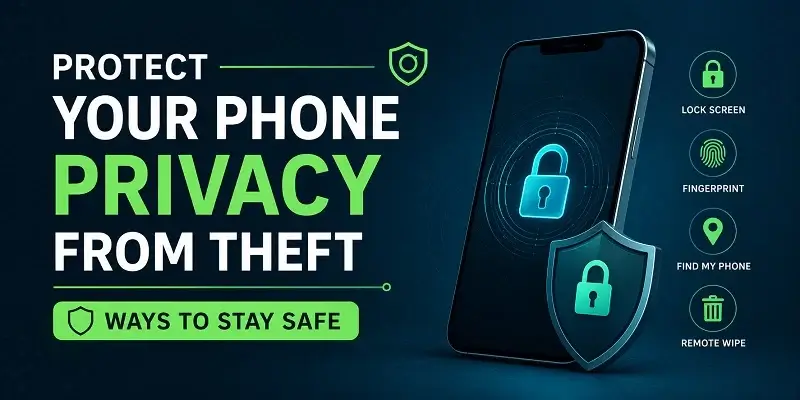
Your smartphone likely holds much of your personal info. This includes photos, bank details, contacts, private messages, and company credentials. Thus, you need to protect your phone from theft and understand common mobile app security concerns that can put your personal data at risk. If someone steals your phone, you might deal with identity theft. You could lose money and face privacy problems, too. Use a strong password, PIN, or screen lock. This helps keep your phone’s privacy safe from theft.
Use a strong screen lock, like a pattern, PIN, or password. This helps keep your phone’s privacy safe from theft. You can add biometrics, like fingerprint or facial recognition. Enable theft protection features like “Remote Lock” and “Identity Check” for added security. Let’s get into the details step by step.
Let’s Set Up a Screen Lock:
As we said earlier, it is the most basic step that you can take to ensure the protection of your phone’s privacy. Experts generally consider passwords the most secure option. Use a strong password and follow password security best practices. It should have letters, numbers, and special characters. This offers better protection. However, if you are more comfortable with a pattern and PIN, feel free to add them. You can also use a password manager to generate strong passwords and store them. You can set the screen lock using the following steps:
Android Phones:
Go to Settings > Security > Screen lock. Then, choose your preferred method: pattern, PIN, or password. Follow the on-screen instructions.
Google Phones:
Go to Settings. Tap Face ID & Passcode (or Touch ID & Passcode). Then, turn on Passcode and follow the on-screen steps to create one.
Apple Phones:
In Settings, go to Security & Privacy. Then, select Device Unlock and Screen Lock. Choose your preferred method: pattern, PIN, or password. Follow the on-screen instructions.
How To Set Up a Pattern Lock on Your Phone
Compared to other screen lock types, experts consider pattern locks less secure. Apple phones don’t support pattern locks. However, Android phones offer this feature for added convenience and security. To set a pattern lock on your Android phone, go to Settings > Security > Screen Lock. Now, select the “Pattern” option and draw your desired pattern. Confirm the pattern by drawing it again, and you are all set. You can choose the grid size for the pattern lock, such as 3×3 or 4×4. You can also decide which notifications to show or hide after the screen locks.
How to Change and Remove the Screen Lock
If you have a screen lock and can’t change or remove it, follow these steps. Go to the Security options above. Enter your current lock screen password or pattern in the prompt if it pops up. Now, tap on “Screen lock” > Screen lock type (if you want to set a different type of screen lock). Select “Pattern” and draw your desired pattern. You will need to confirm the pattern by drawing it again. Tap “Done” to complete the setup.
How To Set Up Face Unlock
To set up Face Unlock, go to your phone’s Settings. Then tap Security and Privacy. Next, select Device Unlock. Then, choose Face & Fingerprint Unlock. Finally, pick Face Unlock or Face Recognition. If you lack a screen lock, set one up first. Follow the on-screen instructions to add your face unlock. You will be asked to capture your face slowly from many angles. After setting up Face Unlock, you can check more settings. This helps boost security. For example, you might add a secondary unlock method.
Face Unlock is also less secure than a strong PIN or password. If someone holds your phone towards your face, they can unlock it. People who look like you can unlock your phone if the face recognition isn’t working well.
How To Set Up PIN Lock
You can find the PIN lock option in the Screen Lock section. If someone asks you to choose a screen lock type, select “PIN.” Now, enter a PIN of your choice (at least four digits, but we recommend six or more for better security). Re-enter your PIN to confirm it. Some devices let you customize what appears on the lock screen. You can choose to show or hide notifications and other items. After you enter and confirm your PIN and make your choices, tap “Done.” Your screen lock is now set.
A PIN lock on a phone offers solid privacy and security. It’s best with a long PIN code, like 6 or 8 digits, especially if it’s randomly generated.
Using 3rd-Party Tools to Protect Your Phone’s Privacy from Theft
You can use third-party security and privacy apps if you can’t access your phone’s security features. They can also add extra security measures. Many users rely on app protection tools like Perfect AppLock. These tools help keep their data and privacy safe. Perfect AppLock has different screen lock options and settings. These help protect your apps and data. This app restricts unauthorized access, ensuring your data stays confidential and protected.
The Perfect AppLock app protects your phone’s privacy from theft. It uses pattern, face, and PIN locks. You can secure newly installed apps and also use a password or gestures. Besides this, you can easily navigate its features through its simple UI and design. Once you install and set up the Perfect AppLock app, you choose a locking method. You can customize your preferred lock for specific apps or hide the app icon using Stealth Mode. You can also access optional settings. These include fake error messages and fingerprint scans for added protection. The Perfect AppLock app is free. You can also buy premium protection with in-app purchases for extra features.
Frequently Asked Questions
1. What is the best way to protect your phone from theft?
To keep your phone safe from theft, set up a strong PIN or password. Use fingerprint or face recognition for unlocking. Also, activate the built-in anti-theft features.
- Keep your phone updated.
- Track its location.
- Don’t leave your phone unattended.
- Never use a simple lock screen method.
2. Is a PIN or password more secure on a phone?
A password is often more effective than a PIN. This is because it has more possible combinations. Besides, a strong PIN may also offer decent protection. Do not use easily combinable sequences such as 1234, 0000, or your date of birth. Use a locking mechanism that is hard for others to crack.
3. Is a fingerprint more secure than a PIN?
The fingerprint system secures phones. You can also use a PIN or password for extra protection. The problem here is that a fingerprint, once compromised, cannot be changed, but a PIN can. So, it is better to combine biometric security with a strong PIN or password.
4. Is Face Unlock safe if someone steals my phone?
Using Face Unlock can be safe. However, its safety relies heavily on the technology in the smartphone. There is a difference in the level of security among different smartphones. In case you lose your phone, having a strong PIN or password provides more safety.
What should I do immediately if someone steals my phone?
If someone steals your cell phone, make sure to take the following steps immediately. First, try to find your phone with the help of your cell phone’s tracking system. Lock your cell phone through the phone’s remote lock facility. Contact your cell phone carrier and have your account blocked or your SIM card blocked.
6. How can I track a stolen phone?
The location services built into the mobile phone may help locate the phone. For instance, one may use Find My Device if one has an Android phone or Find My if one is using an iPhone. The use of these tools should be set up beforehand for locating purposes. One should not try to locate the phone if its whereabouts are dangerous.
7. Can I remotely lock or erase a stolen phone?
Yes, some modern smartphones let you lock or wipe your stolen device remotely. You can do so by using Google’s Find My Device feature for Android phones and the Find My iPhone feature on iPhones. The former helps you avoid any access to your data, while the latter wipes all your data.
8. What Is Android Theft Protection?
Android Theft Protection helps keep your phone and data safe if it’s stolen. The available features can differ based on the device and the Android version. This includes Theft Detection Lock, Offline Device Lock, Remote Lock, and more.
9. What Is Remote Lock and Identity Check on Android?
The Remote Lock feature lets you lock your Android smartphone from afar if it’s lost or stolen. This helps keep your personal data safe. The Identity Check feature adds extra security for sensitive activities. This is especially important when the device is in an insecure location.
10. What does Stolen Device Protection do on iPhone?
Stolen Device Protection is a feature on the iPhone. It keeps your private data safe if someone who knows your password takes your device. Stolen Device Protection might require Face ID or Touch ID at times. This can lead to security delays.
11. Can someone use a stolen phone for identity theft?
Yes, if thieves access your personal data, they can steal your identity. This includes your accounts, messages, and saved passwords. To reduce this risk, use a strong screen lock. Enable two-factor authentication. Turn on device encryption and theft protection. Also, rapid action, such as blocking or wiping a phone, is useful.
12. What security settings should I enable before someone steals my phone?
Before someone steals your phone, set up a secure screen lock, fingerprint, or Face ID. Also, enable tracking, remote locking, and automatic security updates. Turn on Android Device Theft Protection and Stolen Device Protection where possible. Use two-factor authentication where necessary, and update your recovery info.
Conclusion:
Cybercrimes and digital fraud are increasing day by day. Thus, you should use countermeasures to protect your phone’s privacy from theft. These apps keep your data safe. They help stop identity theft and block harmful cyberattacks.
To protect your device, use these tips:
- Find My Phone
- Tracking apps
- Strong passwords or PINs