
Hey guys! In this post, we’ll discuss what copyright is and share five essential tips to help bloggers avoid copyright issues and create better SEO content. Let’s get started.
Plagiarism is one of the most common causes of copyright problems. Using another author’s work without proper credit can lead to copyright complaints or other legal issues.
According to Moz, about 29% of websites contain duplicate content. But does duplicate content always lead to copyright strikes? No. Duplicate content and copyright infringement are not the same thing. Still, copying someone else’s work without permission can create serious problems.
So, how can you avoid copyright issues? What steps should you take when creating blog content?
Let’s explore these questions and learn how to protect your content while improving your SEO and content marketing.
What Is Copyright?
Copyright is a legal right that protects original creative work. It gives the creator control over how others can use, copy, sell, or distribute their work.
Copyright can protect many types of creative content, including:
- Articles and other written content
- Music
- Videos
- Images
- Designs
- Other original creative works
Using copyrighted work without permission can lead to legal action or financial penalties, depending on the situation and local laws.
3 Types of Copyrighted Works in Marketing
Copyright applies to many types of content used in marketing. Understanding the main categories can help you avoid using someone else’s work without permission.
Here are three common types of copyrighted works:
1. Literary Works
Literary works include articles, blog posts, books, and other written content.
If a website publishes an original article, that content may be protected by copyright. Copying the article without permission can lead to copyright problems.
2. Dramatic and Audiovisual Works
This category includes videos, films, and other audiovisual content.
For example, YouTube videos and other marketing videos may be protected by copyright. You should not copy or reuse this content without permission or a suitable license.
3. Pictorial and Graphic Works
This category includes photographs, illustrations, graphics, logos, and other visual content.
Copyright can protect images and other visual elements used on websites, blogs, social media, and marketing materials. Always check the usage rights before using someone else’s visual content.
5 Essential Tips for Bloggers to Avoid Copyright Issues
The best way to avoid copyright problems is to create original content. Do your research, use your own words, give credit when needed, and check your work before publishing it.
Here are five simple tips to follow.
1. Understand Your Topic Before You Write
Before writing an article, learn the topic well and follow these blog writing tips. Good research helps you understand the subject and develop your own ideas.
Focus on:
- Learning the basics
- Understanding the important details
- Finding out what people commonly believe
- Checking whether common claims are accurate
- Developing your own point of view
Your own ideas make your content more original. The better you understand your topic, the easier it becomes to explain it in your own words.
2. Learn How to Paraphrase Properly
Paraphrasing means expressing someone’s idea in your own words. However, simply changing a few words is not enough. Close paraphrasing can still create plagiarism or copyright concerns.
Follow these steps:
- Read the original content carefully.
- Identify the main ideas.
- Put the original text away.
- Explain the ideas in your own words.
- Add your own analysis or examples.
- Cite the source when appropriate.
Article rewriter tools can help you rewrite text, but you should not rely on them to make copyrighted content safe to use. Always review the result and add your own ideas.
3. Check Your Content for Plagiarism Before Publishing
Always check your blog posts before you publish them.
Use a reliable plagiarism checker to compare your content with other material online. If the tool finds copied or overly similar text, review and rewrite those sections.
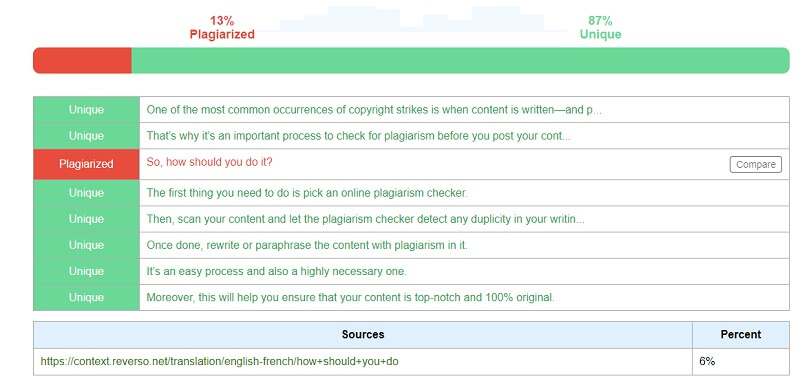
Plagiarism checkers are useful, but they are not perfect. They can sometimes flag common phrases or legitimate quotations.
A final plagiarism check can help you catch problems before your article goes live.
4. Cite Your Sources Properly
Give credit when you use information, ideas, quotes, statistics, or other material from another source.
A simple blog citation can include:
- Author’s name
- Publication date
- Blog post title
- Link to the original article
You can also add an outbound link to the source.
Remember that citing a source does not automatically permit you to copy it. If you use copyrighted material, you may still need permission or a suitable license.
5. Use Direct Quotes Carefully
Sometimes you may want to include an exact quote from another writer. When you do, clearly mark it as a quote and credit the original author.
For example:
“Content is king.”
Use only the amount of text you need, and add your own explanation or analysis.
A citation does not automatically make unlimited copying acceptable. Keep quotes short and make sure your use follows applicable copyright rules.
Frequently Asked Questions
1. What is the difference between copyright and plagiarism?
Copyright is a legal right that protects original creative work. Plagiarism is presenting someone else’s work or ideas as your own without proper credit.
They are related but not the same. Copyright infringement can have legal consequences, while plagiarism can also damage your reputation and credibility.
2. Does duplicate content automatically mean copyright infringement?
No. Duplicate content does not automatically mean copyright infringement.
Similar or duplicate content can appear for many legitimate reasons, such as product descriptions, quotations, syndicated articles, or content published in multiple places.
However, copying an entire article without permission can create copyright problems.
3. Does citing a source prevent copyright infringement?
No. Citing a source gives credit to the original creator, but it does not automatically permit you to copy their work.
When possible, create original content. If you need to use copyrighted material, check whether you have permission, a license, or another legal basis for using it.
4. How can bloggers avoid copyright infringement?
Bloggers can reduce copyright risks by:
- Writing original content
- Using properly licensed images
- Getting permission when necessary
- Giving credit where required
- Avoiding large portions of copied content
- Checking the usage rights of third-party material
5. Can paraphrasing copyrighted content cause copyright problems?
Yes. Paraphrasing does not automatically make copyrighted content free to use.
If your version follows the original too closely, it may still create copyright or plagiarism concerns. Instead, understand the source, explain the idea in your own way, and add your own analysis.
6. Can I use images from Google on my blog?
You should not assume that images found on Google are free to use.
Google displays images from many websites, and those images may be protected by copyright. Check the image’s license and usage rights before using it.
You can also use your own images or images from reputable sources that provide clear licensing terms.
7. How much copyrighted content can I use without permission?
There is no universal percentage or word limit that automatically makes copyrighted content safe to use.
The answer can depend on factors such as how much you use, why you use it, and the laws that apply. Some uses may qualify for legal exceptions, such as fair use in the United States, but this depends on the specific circumstances.
8. Does plagiarism hurt SEO rankings?
Plagiarism and low-quality duplicate content can hurt a website’s performance.
Search engines aim to follow important SEO principles by providing useful, original, and relevant results. If your content adds little value or closely duplicates content that already exists, it may struggle to rank well.
9. How can I check my blog for plagiarism before publishing?
Use a reputable plagiarism checker before publishing your article.
These tools compare your text with content from websites and other sources. They can help you find sections that may need rewriting or citation.
Keep in mind that plagiarism checkers are not perfect and may sometimes flag legitimate matches.
10. Can I quote another website or blogger in my article?
Yes, you may be able to use short quotes from another website or blogger, depending on the circumstances.
Keep quotes relevant and limited. Clearly identify the original author and source, and add your own explanation or analysis.
Conclusion
The best way to avoid copyright problems is to follow an effective content creation strategy focused on producing original content.
Research your topic carefully, understand the subject, write in your own words, cite your sources, and check your content before publishing. When you use images, quotes, or other third-party material, always check the usage rights.
These simple steps can help you create trustworthy content and write blog posts that rank high on Google while reducing plagiarism and copyright risks.
I hope this guide helped you understand copyright and the five essential tips bloggers can use to create original content and support their SEO efforts.
If you have any questions about copyright, plagiarism, or SEO, feel free to share them in the comments.