
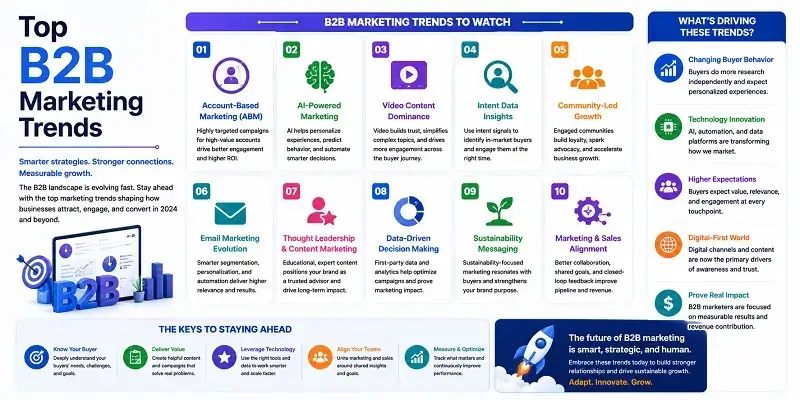
Hey guys, in this article, we will discuss the top 6 B2B marketing trends in 2026. So keep reading.
The B2B marketing arena has undergone tremendous change in the past decade. Earlier, the key goal of B2B marketing was to gain a face-to-face meeting with a prospect. Today, automation and digitalization have taken a central role.
The move to digitalization isn’t new. However, it has sped up quickly lately. This change is driven by rising uncertainty and shifting business needs. Many industries are adopting automation and digital processes. They’re moving away from traditional methods. B2B marketing is also following this trend. Marketing automation is now a key strategy. It boosts efficiency, streamlines campaigns, and improves customer engagement.
Tactics like storytelling, meaningful content, positioning, and customer retention are becoming popular in B2B marketing. Differentiating from competitors is also important.
Without further ado, let’s look at the top B2B marketing trends in 2026.
Table of Contents:
3. Artificial Intelligence (AI)
1. Omnichannel Marketing
The term omnichannel marketing has been around for the past few years. It means a consistent experience regardless of the device used.
Today, 90% of customers want consistent interaction across all channels.
In the past, most customers likely had only two touchpoints with the business. Today, a customer has an average of six touchpoints. This means you need consistency in your marketing across all those touchpoints.
Omnichannel marketing is crucial. Yet, over 55% of businesses lack a cross-channel strategy.
Today, businesses must keep a consistent brand voice. This is important for all marketing channels: social media, websites, and physical stores.
2. Customer Experience
The next logical step from omnichannel marketing is customer experience.
The B2B industry has changed a lot in the last ten years. Still, it struggles with providing a smooth customer experience.
Many B2B buyers are now spending more time at home. So, it’s vital to create interactive content. This lets them engage with your brand effectively.
Presently, almost 73% of B2B buyers are millennials. What does that mean for the B2B industry?
Millennials are a digital-first generation; they expect brands to deliver great customer experiences.
Critical reviews on Google or social media can hurt your business quickly. Slow-loading sites, poorly done cold calls, and hard-to-access info also damage your reputation. This can erode customer trust fast.
3. Artificial Intelligence (AI)

Data is expected to rise by 61% by 2026. With so much data, AI will play a key role in all industries, including B2B. AI is a strong tool. It helps businesses look at large data sets and make informed choices.
Forbes says sales and marketing teams use machine learning and AI 40% more than other departments in big companies. With AI, businesses can discover details about their users. This includes demographics, where they live, and their shopping preferences.
Netflix shows how businesses can use AI to create a personalized user experience. It tailors content based on what you watch and your interests.
4. B2B Content Marketing
Before we talk about the benefits of B2B content marketing, let’s define it. We’ll also see how it’s different from B2C content marketing.
B2B content marketing is about using content to educate and grow brand awareness. It helps generate leads and boost sales.
What sets B2B content apart from B2C is that it should be actionable and useful. If your customers can’t use your advice in real life, your content is missing the mark.
This does not mean that B2C content is not useful; it means that B2B has more restrictions. Imagine if Intel started publishing content in the entertainment industry. Would it convert? Is entertaining content useful for Intel’s buyers? Nope.
B2B content marketing can be a strong tool. When used correctly, it helps generate leads and boost organic traffic through SEO.
5. Personalization
The importance of personalization is rising in the digital space, and B2B is no exception. Consumers today expect brands to value them. They want targeted, relevant, and personalized solutions.
The same goes for email, which used to be the second-best marketing channel for B2B marketers. It’s no longer a game of mass emails with low response and open rates.
B2B marketers can now use advanced data analytics and email tools. These help them segment audiences and personalize messages for various customer groups. Modern audience engagement tools let you track user behavior. You can send targeted messages and build stronger relationships with potential clients.
A Campaign Check study found that personalized emails boosted transaction rates by 6%. It’s now crucial to offer users a personal and smooth experience.
6. Local Search Optimization

Most businesses are so busy with global SEO that they forget the power of local SEO. Geo-targeting helps customers find your location, contact info, reviews, and more. This is especially important if your business serves customers physically.
Furthermore, Google My Business plays an important role in local search optimization. Hence, it is necessary to maintain excellent reviews.
To optimize for local search, keep your business information updated. If customers see that your address is wrong on the listing, they might lose trust in your B2B brand.
B2B Marketing Trends
| B2B Marketing Trend | Main Purpose | Key Benefit | Best Platform/Method |
|---|---|---|---|
| Omnichannel Marketing | Consistent customer experience | Improves customer engagement | Social media, email, website |
| Customer Experience | Better user satisfaction | Builds trust and loyalty | Websites, support systems |
| Artificial Intelligence (AI) | Data analysis and automation | Improves decision-making | AI tools and automation software |
| B2B Content Marketing | Educate and generate leads | Boosts SEO and traffic | Blogs, whitepapers, LinkedIn |
| Personalization | Customized customer interactions | Increases conversions | Email marketing and CRM |
| Local Search Optimization | Improve local visibility | Attracts nearby customers | Google Business Profile |
| Video Marketing | Visual engagement and education | Higher engagement rates | YouTube, webinars, LinkedIn |
Frequently Asked Questions
What are B2B marketing trends?
B2B marketing trends are current ways that companies reach out to other businesses. These methods help organizations connect for business goals. Some of the trends include AI, personalization, content marketing, omnichannel marketing, and automation.
Staying current with trends helps businesses in several ways:
- It improves lead generation.
- It boosts customer engagement.
- It enhances online visibility.
- It supports growth in a competitive market.
Why is personalization important in B2B marketing?
Personalization allows organizations to deliver relevant information and tailored experiences to their customers. It boosts customer satisfaction, builds strong relationships, and helps both the business and the client in the long run. Many businesses use the top free WordPress client portal plugins. These help with personalized communication, organizing customer interactions, and enhancing service management. As a result, organizations can increase client retention and build stronger long-term relationships.
How does AI help B2B marketing?
Artificial Intelligence helps organizations analyze large amounts of customer data quickly and accurately. AI-powered apps help marketers automate tasks. They also improve customer targeting and deliver personalized recommendations. Plus, they predict customer behavior more effectively. Artificial intelligence is changing how businesses market. It makes processes faster, relies on data, and focuses on results.
What is omnichannel marketing in B2B?
Omnichannel marketing aims to create a smooth customer experience. It works across different platforms like websites, social media, emails, and mobile apps. It helps businesses shape their brand identity. It also enhances customer relationships and ensures consistent interactions with their audience. A great way to boost your agency’s brand visibility is by using an effective omnichannel marketing strategy. This method boosts engagement. It also enhances customer satisfaction and keeps your brand linked with users at all digital touchpoints.
Why is content marketing important for B2B companies?
Content marketing helps B2B companies in a few key ways. It educates potential customers, builds authority, and establishes trust in their industry. Quality blogs, how-to guides, videos, and case studies boost SEO rankings. They also draw in valuable leads. Educationbeing.com: Learn – Lead & Excel shows how engaging content can attract audiences. It helps businesses turn prospects into loyal customers. It does this by offering consistent value and expertise.
Wrapping Up
Technology is growing rapidly, and B2B brands need to keep up with it. B2B marketing must stay updated as the marketing landscape keeps changing. That being said, B2B marketing trends are still relevant if you want to reach new goals in 2026. Consider all the above trends to help you create a high-conversion marketing strategy.
Search engine optimization, video marketing, and local search optimization are key for B2B companies. They help boost online visibility and generate leads. Trust is vital for growth. Share useful information and keep communication steady across all channels. Companies that combine technology with a human touch in marketing can achieve better results.
What are your thoughts on B2B marketing? Please share them with us in the comments below.